
Job Loss? What Science Says About Visualizing Your Way Back

Picturing success can backfire. Seeing the process changes everything.

…it struck me what quality went to form a Man of Achievement, especially in Literature, and which Shakespeare possessed so enormously - I mean Negative Capability, that is, when a man is capable of being in uncertainties, mysteries, doubts, without any irritable reaching after fact and reason. — John Keats
If you’re reading this with a severance letter still open on your PC, you are not alone. The U.S. unemployment rate has ticked up to 4.2% in 2026, and according to outplacement firm Challenger, Gray & Christmas, U.S. employers announced 529,914 job cuts in the first eight months of 2026. While that’s fewer than last year, one of those cuts might have your name on it.
A job layoff hits more than your bank account. It changes your routine, your identity, and the narrative you tell yourself about who you are.
Friends, family, and others often don’t understand your situation, especially if they’ve never lost a job, so their advice of “visualize success” or “keep showing up” is moot. But science supports how you use your mind in moments like this. While some of it backs the visualization advice you’ve heard before, some of it says you’ve been doing it wrong.
The Beginnings of Mental Imagery
Sometime in 1930, Dr. Edmund Jacobson, a Chicago-based physician specializing in physiology, asked a patient lying on his lab table to imagine lifting his right arm. Wired with electromyography equipment to measure muscle stimulation, the patient visualized the muscles involved in raising his arm.
Imagine the scene. The machine blipped and whined, needles jumping. Jacobson might have said, “Ahh, do you see? Muscle stimulation from mental imagery.”
What Jacobson showed was revolutionary. Imagined movement produced small electrical signals in the muscle.
The experiment demonstrated that cognitive processes—or more specifically, mental imagery—can ignite physical performance, an idea later called psychoneuromuscular theory by researchers (many theories would follow based on Jacobson’s research).
While empirical evidence that mental visualization improves athletic performance would not arrive until later, Jacobson set the foundation for mentally practicing a skill before the physical skill took place.
In another 2013 study, researchers pooled 75 brain-imaging studies and found that motor imagery uses a large network that overlaps with real movement, but the primary motor cortex wasn’t consistently active.
Imagery Limitations
This is what the research actually shows. In 2004, researchers at the Cleveland Clinic had volunteers imagine pushing their little finger sideways as hard as they could, 15 minutes a day, five days a week, for 12 weeks. They never moved the finger, yet its strength improved 35%. The group that did the actual physical movement gained 53%.
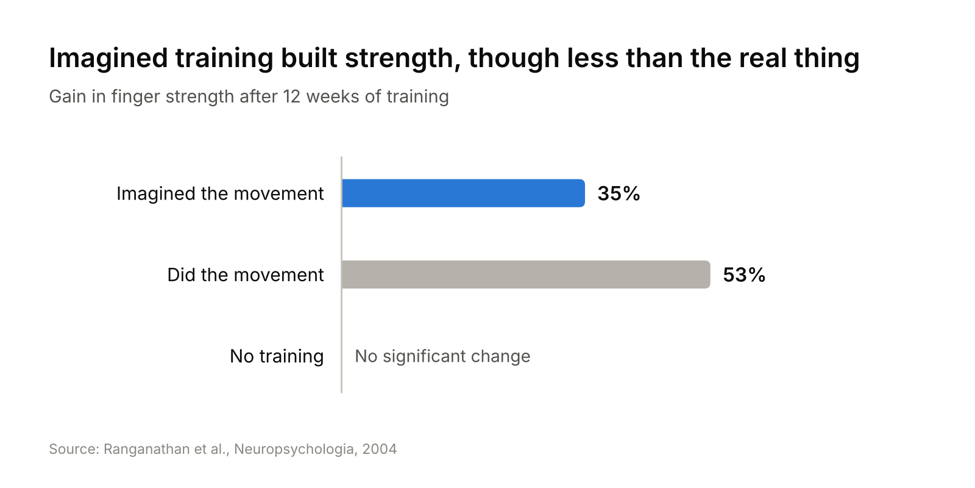
A 2020 review of 37 studies came to a similar conclusion. Mental practice improves performance, but the effect is small.
So imagery is most effective as a rehearsal for action, but it cannot replace the action. Visualizing your success in challenging situations activates many of the same areas that experience it physically. This promotes neuroplasticity—the brain’s ability to rewire and form new connections.
History contains a vast library of characters who used visualization to accentuate their creative lives, and the popularity of modern-day works such as Shakti Gawain’s Creative Visualization (1978) and Rhonda Byrne’s The Secret (2006) reflects its fascination.
Nikola Tesla was a master of mental acuity. “I do not rush into actual work,” he wrote in 1919. “When I get an idea I start at once building it up in my imagination. I change the construction, make improvements and operate the device in my mind.”
Thomas Edison had a different approach. He would nap in a chair holding steel balls in his hand. As he fell asleep, his grip relaxed, the balls hit the floor, and the noise woke him, often with an idea in his head.
In 2021, researchers in Paris examined this. Participants who spent at least 15 seconds in that half-asleep stage were nearly three times as likely to solve a secret pattern in a math problem, 83% versus 30%.

You can try it. After an exhausting day of job searching, find a comfortable position for a 20-minute nap. Keeping a notepad nearby, hold keys or some metal object as you drift off to sleep.
Picture the Process
Here is the real part that most visualization advice skips—and it’s what matters if you’re looking for your next career role.
Gabriele Oettingen, a psychologist at NYU, observed university graduates as they sought employment. The graduates who spent the most time daydreaming about landing a dream job put in less effort and did worse. Her explanation: when you vividly picture the win, your brain relaxes a little, as if you’ve already gotten it.
Before a midterm, UCLA researchers found the same pattern among students. The ones who pictured themselves getting an A did worse than the ones who pictured themselves studying: where they’d sit, which chapters they’d open, how they’d push past boredom.
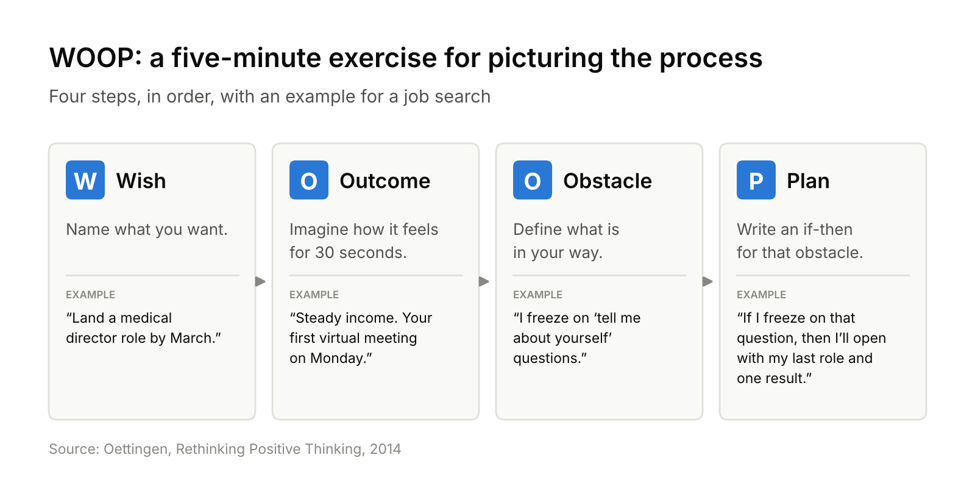
Oettingen designed a four-step exercise called WOOP:
Wish: “Land a medical director role by March.”
Outcome: Imagine how it feels for 30 seconds. Steady income. Your first virtual meeting on Monday.
Obstacle: Define what is in your way. “I freeze on ‘tell me about yourself’ questions.”
Plan: Write an if-then. “If I freeze on that question, then I’ll open with my last role and one result.” Give it a try. It takes about five minutes.
Bruce Lee once told writer Joe Hyams that when a negative thought entered his mind, he visualized writing it down on paper and mentally burning it. That trick now has science behind it.
In 2013, researchers at Ohio State and Madrid had people write down either positive or negative thoughts about their bodies. Some ripped up the paper and threw it away—those people were less influenced by those thoughts after. In a second experiment, people who folded the paper into a pocket leaned on those thoughts more.
In a third study, imagining throwing the thought away worked less effectively than physically doing so. So take the negative thoughts, write them down, and tear them up.
Writing helps too. In 1994, psychologist James Pennebaker worked with laid-off senior engineers with 20 years at the same company (much like the big tech layoffs in 2026). He had them write about their fear and anger for 20 minutes a day for five consecutive days. Eight months later, 52% of that group had full-time jobs. For the groups that did not do the expressive writing, less than 19% did. While writing didn’t make them better at their jobs, it discarded enough of the anger so they could interview without it.

Mental imagery is a science-backed concept that can help you improve a skill or achieve goals. Yet for many, visualizing is not easy. Sometimes thoughts get in the way, but some might not see anything. If you close your eyes and see a blank canvas, nothing is wrong with you. About 1 in 100 people have aphantasia, or no visual imagery at all, and another 3% have very scant imagery.
Use words instead. Talk out loud through the scenes you’re trying to see and go through each step as though you are doing them.
Embracing Uncertainty
Understanding uncertainty as an ineradicable feature of the world, as many physicists do, makes uncertainty not our fault and not just a problem about human knowing. — Richard C. Sha
Embracing uncertainty is difficult. When you have bills to pay and no paycheck, your mind focuses on lack—but this is not weakness.
A review of more than 300 studies found that around 34% of unemployed people suffer from major psychological distress, compared with 16% of people with jobs. The stress is palpable, and it isn’t a mindset problem.

What you can control is where you place your attention. While lack is temporarily real, it isn’t the entire picture. You are still the same person you were before your job loss—you have skills, a network, and a few hours today—point your imagery there. You must, as Coleridge said, suspend disbelief—aware of negative thoughts but able to set potent images in your mind to replace them.
Your situation is temporary, but the skills and resilience you developed to get here are permanent.
Sources list
Challenger, Gray & Christmas. (2026, Sept. 3). Challenger Report: August Job Cuts Up 58%, Consumer Products, Food Lead. https://www.challengergray.com/blog/challenger-report-august-job-cuts-up-58-consumer-products-food-lead/
U.S. Bureau of Labor Statistics. (2026, Oct. 2). The Employment Situation – September 2026 (USDL-26-1549). https://www.bls.gov/news.release/archives/empsit_10022026.htm
Paul, K. I., & Moser, K. (2009). Unemployment impairs mental health: Meta-analyses. Journal of Vocational Behavior, 74(3), 264–282. https://doi.org/10.1016/j.jvb.2009.01.001
Spera, S. P., Buhrfeind, E. D., & Pennebaker, J. W. (1994). Expressive writing and coping with job loss. Academy of Management Journal, 37(3), 722–733. https://doi.org/10.5465/256708
Jacobson, E. (1932). Electrophysiology of mental activities. American Journal of Psychology, 44(4), 677–694.
Lin, C.-H., et al. (2022). Combinations of action observation and motor imagery on golf putting’s performance. PeerJ, 10, e13432. https://doi.org/10.7717/peerj.13432
Ranganathan, V. K., et al. (2004). From mental power to muscle power: Gaining strength by using the mind. Neuropsychologia, 42(7), 944–956. https://doi.org/10.1016/j.neuropsychologia.2003.11.018
Hétu, S., et al. (2013). The neural network of motor imagery: An ALE meta-analysis. Neuroscience & Biobehavioral Reviews, 37(5), 930–949. https://doi.org/10.1016/j.neubiorev.2013.03.017
Toth, A. J., McNeill, E., Hayes, K., Moran, A. P., & Campbell, M. (2020). Does mental practice still enhance performance? A 24 year follow-up and meta-analytic replication and extension. Psychology of Sport and Exercise, 48, Article 101672. https://doi.org/10.1016/j.psychsport.2020.101672
Wright, D. J., et al. (2024). An international estimate of the prevalence of differing visual imagery abilities. Frontiers in Psychology, 15, 1454107. https://doi.org/10.3389/fpsyg.2024.1454107
Oettingen, G., & Mayer, D. (2002). The motivating function of thinking about the future: Expectations versus fantasies. Journal of Personality and Social Psychology, 83(5), 1198–1212. https://pubmed.ncbi.nlm.nih.gov/12416922/
Oettingen, G. (2014). Rethinking Positive Thinking: Inside the New Science of Motivation. Current.
Pham, L. B., & Taylor, S. E. (1999). From thought to action: Effects of process- versus outcome-based mental simulations on performance. Personality and Social Psychology Bulletin, 25(2), 250–260. https://doi.org/10.1177/0146167299025002010
Gollwitzer, P. M., & Sheeran, P. (2006). Implementation intentions and goal achievement: A meta-analysis of effects and processes. Advances in Experimental Social Psychology, 38, 69–119. https://doi.org/10.1016/S0065-2601(06)38002-1
Briñol, P., Gascó, M., Petty, R. E., & Horcajo, J. (2013). Treating thoughts as material objects can increase or decrease their impact on evaluation. Psychological Science, 24(1), 41–47. https://doi.org/10.1177/0956797612449176
Lacaux, C., et al. (2021). Sleep onset is a creative sweet spot. Science Advances, 7(50), eabj5866. https://doi.org/10.1126/sciadv.abj5866
Tesla, N. (1919, February). My Inventions: I. My Early Life. Electrical Experimenter. https://teslauniverse.com/nikola-tesla/articles/my-inventions-i-my-early-life
Sha, R. C., & Harshman, N. (n.d.). Uncertainty isn't a human flaw, it's a feature of the world. Psyche. https://psyche.co/ideas/uncertainty-isnt-a-human-flaw-its-a-feature-of-the-world
Keats, J. (1817, Dec. 21/27). Letter to George and Tom Keats ("negative capability").
Coleridge, S. T. (1817). Biographia Literaria, Ch. 14 ("willing suspension of disbelief").
Hyams, J. (1982). Zen in the Martial Arts. Bantam. (Original work published 1979)


Comments